
To the right bank of the Bagmati River, sacred in the land of six thousand rivers, a stone's throw from Kathmandu airport, the walls of the great golden temple of Pashupatinah, dedicated to the almighty god Shiva, protector of Nepal. On that same side, on the smooth greenish slate of the stairs [ghat], where the sun exercises, runs and enters first every morning, the world and the dead parade.
The Hindu ritual of outdoor cremations [antyeshti] urges families to celebrate it urgently from the eve, in a public ceremony charged with the utmost sensitivity, provided only by Brahmin priests—a caste that in Nepal is called bahun— from the same enclosure [ghat bahun].
Economic status, ethnicity, and caste also distinguish funerals here. But that doesn't change the rawness of the gesture and the hands with which a Nepalese man is capable of slashing a goat's neck cleanly to offer its blood to the goddess Daxinkali, which becomes profoundly fragile when he accompanies his dead.
The level of emotion with which the funeral hours are conducted, beyond comparison, makes what might initially appear to be of insurmountable coldness, in the eyes of a European, come to be viewed with astonishing closeness and even strange affection.
LThe elements decompose, everything decomposes and re-orders; it is not so far from Heraclitus❞.
The elements break down, everything breaks down and rearranges; Heraclitus is not that far away. It is the same universe and the same philosopher who assured that none of the gods or men did it, that it has been eternally and is and will be an eternally living fire, which turns on and off according to measurements. Although, yes, the flames in the cremation of the mythical hero Achilles approached wine instead of water to suffocate it.
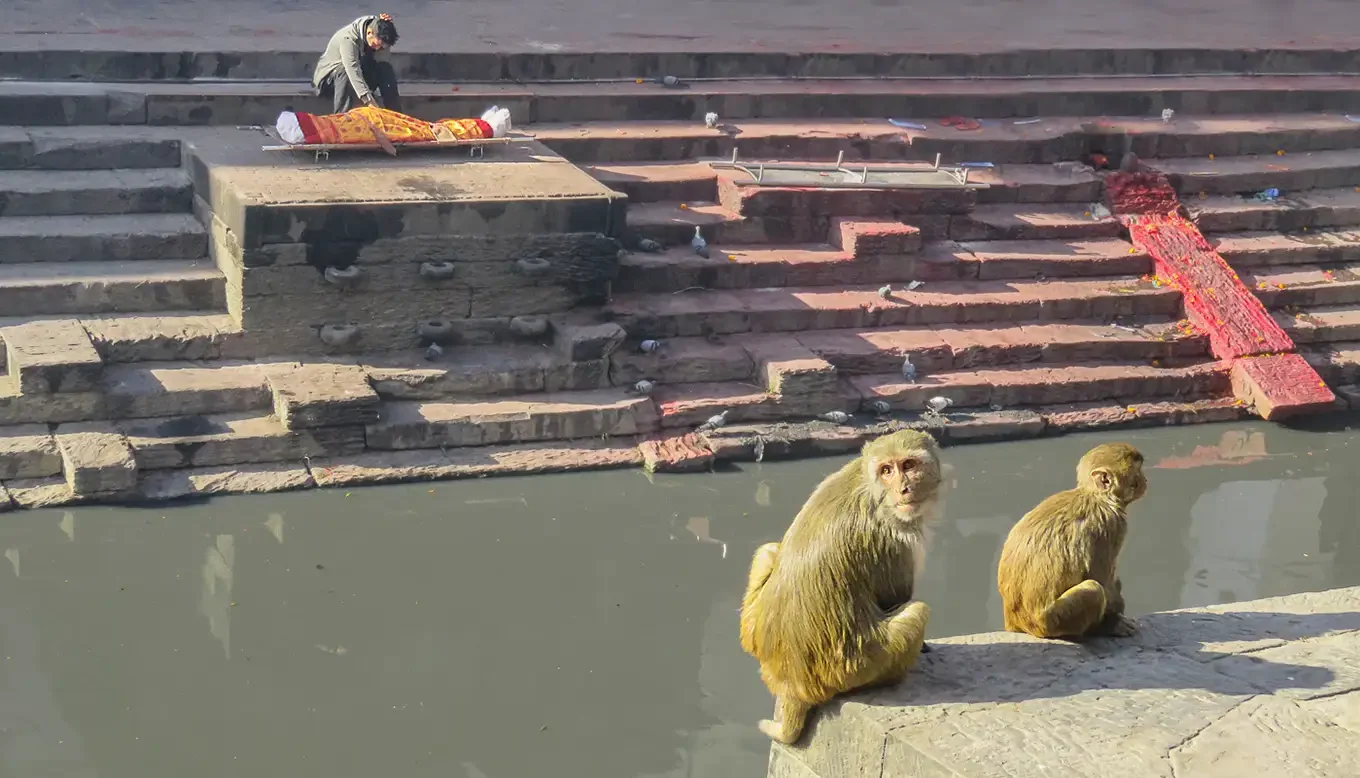
The different scenes of the mourning on the same steps during the funeral.
The shady massacre that occurred in 2001 at the Narayanhity Palace, the official residence of the Nepalese royal family, which, together with the regicide perpetrated by the eldest son, took nine more relatives, would bury the Shah dynasty and would soon lead to the abolition of the monarchy and the proclamation in 2005 of the current republic with democratic aspirations.
Until then, Pashupatinah Temple had been an immemorial witness to the funerals of the royalty and court, reserving the ghat in this aforementioned stretch of the river for its exclusive funerary use, but from now on what had historically run through multiple places scattered throughout the extensive network of water arms that flow through the capital will be concentrated here. However, there are ghats which have continued to maintain their funerary uses, such as those in the vicinity of the Uma Maheshowr temple on the Bishnumati, among others.
Separated by a bridge, two sections of ghats, a shorter and more relevant one, the so-called noble staircase [arya ghat], which falls just below the eastern door of the temple, with only two platforms where cremations can be held, and the most extensive, below, called del sol [surya ghat], currently used by the bulk of the population.
In turns, without rest, night and day, death travels the line of ghats that cut at the base of the temple the sacred water of the holiest of the eight rivers that flow through old Kathmandu and end up merging with the living flow of the Ganges downland. At this same point, shrouded Kathmandu residents arrive for cremation.
Outside the city gates, in a thick, thin atmosphere that covers everything, each of them slowly enters on a litter, carried by the men of their families to the place where they will be purified and bid farewell. The time of mourning begins to become heavy and slow, and the funeral ritual necessary before cremation begins, the most intimate moment, that of a long goodbye.
LDeath walks the row of ghats night and day❞.
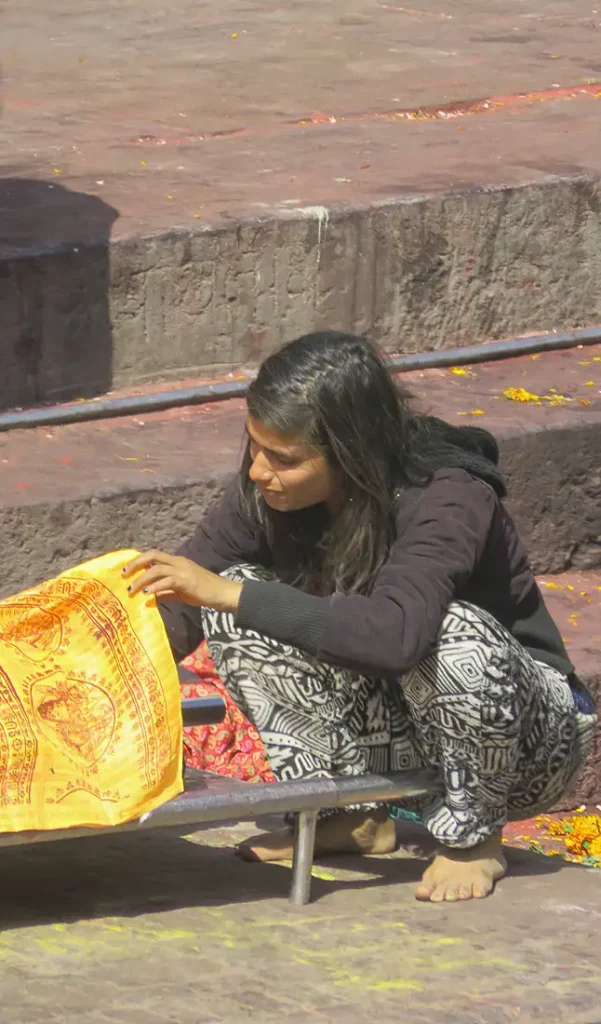
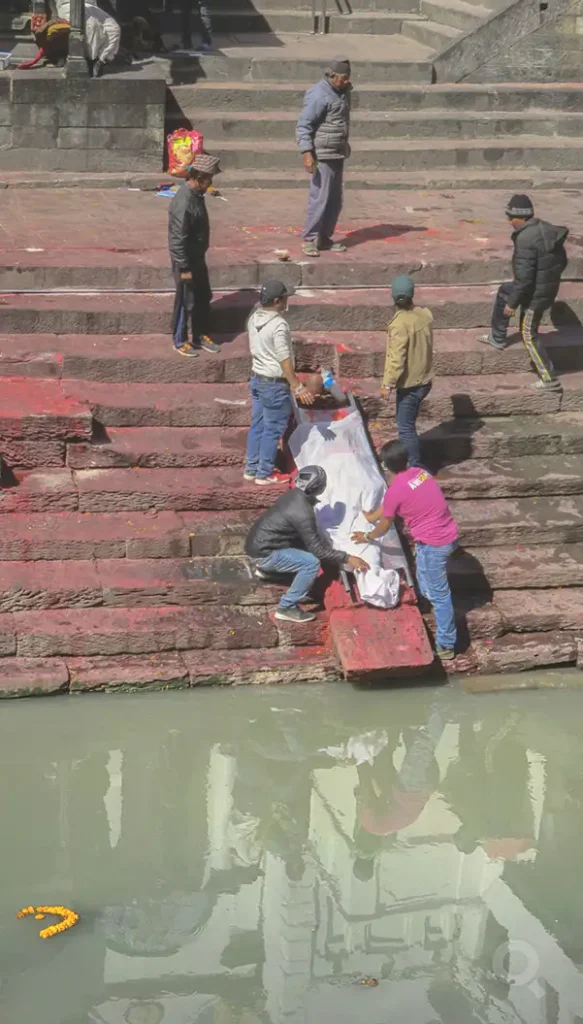
The deceased is then gently picked up and posed on the ground so that it comes into contact with the earth while waiting to be brought closer and supported on a sloping slab [brahmanical], arranged on the same staircase for this purpose, where it will remain carefully suspended to facilitate its purification. Face and limbs are left exposed, free to be sprayed with milk and water trapped between the hands from the very surface of the river. Family and friends will pay their respects to the deceased by bowing their heads with their hands palms open, joined together and held to their chest. until his forehead, like a spring, hits the fallen tips of the deceased's feet.
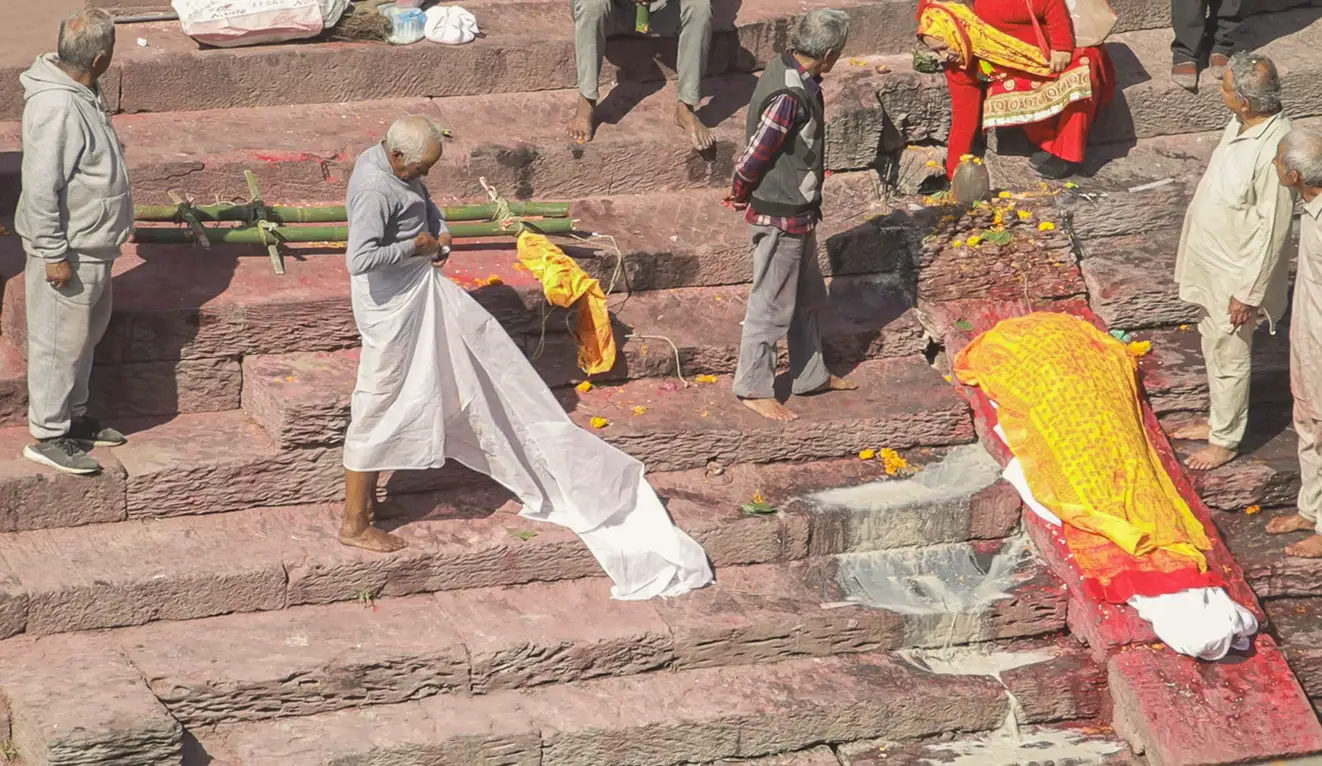
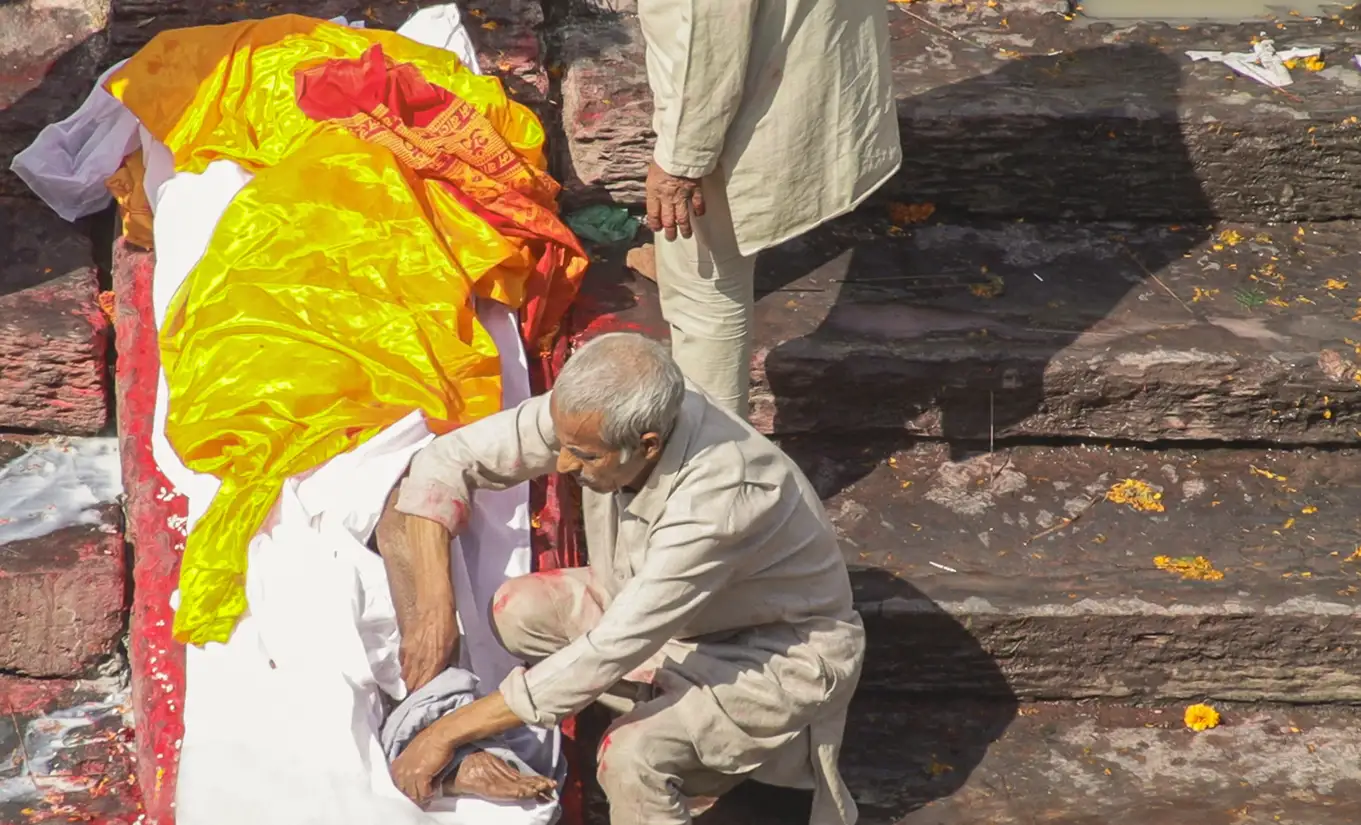
Sequence of preparations for the ritual to purify corpses.
The moment of the offerings
In this preparation for cremation, the most emotional, the moment of the offerings: sticks of incense, fresh marigolds the color taken from saffron and a singular petricor smell of detained blood, rice balls, in which the local pigeons will immediately participate indifferently, and red powder that is scattered and with which the forehead is covered. deceased.
From there, returned to the stretchers, the shroud is readjusted again, sometimes other colored scraps and inscriptions are superimposed, and even clothes of the deceased or a family member are placed on the torso, even food, and then carried in a procession preceded by sharp and auspicious blows of conch rituals [shankha], Come in mantras, which resound successively during the short journey to the pyre, marking like a morse from beyond the grave the salute to the four winds and announcing the passage of death, purifying the air and conjuring up the origins of creation itself.
In that penetrating sound is the whole, a persistent rite with the identification of the elements that recalls, once again, the Fragments of Heraclitus: the death of the earth is to become water, the death of water is to become air, the death of the air is to become fire, and vice versa.
During the journey to the pyre, ritual conch shells resonate like a Morse code from beyond the grave announcing the passing of death.❞.
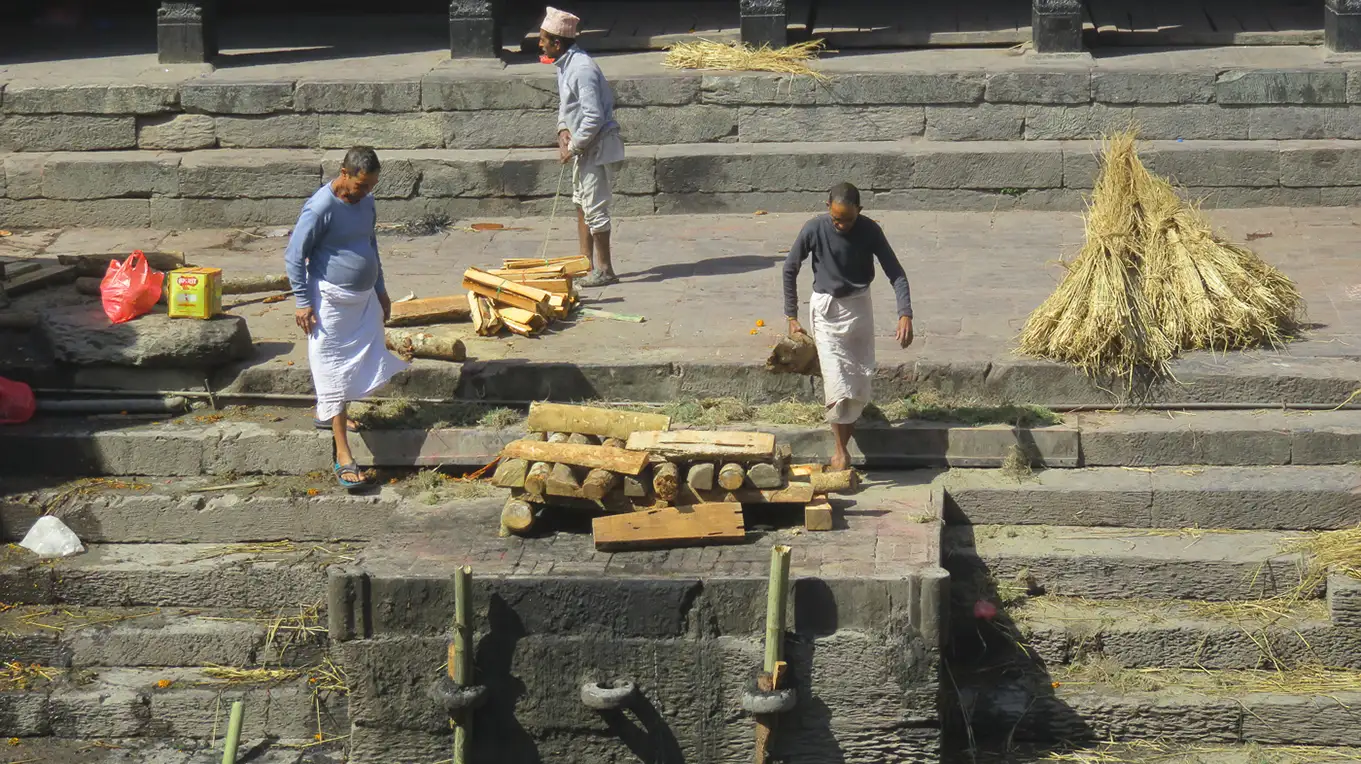
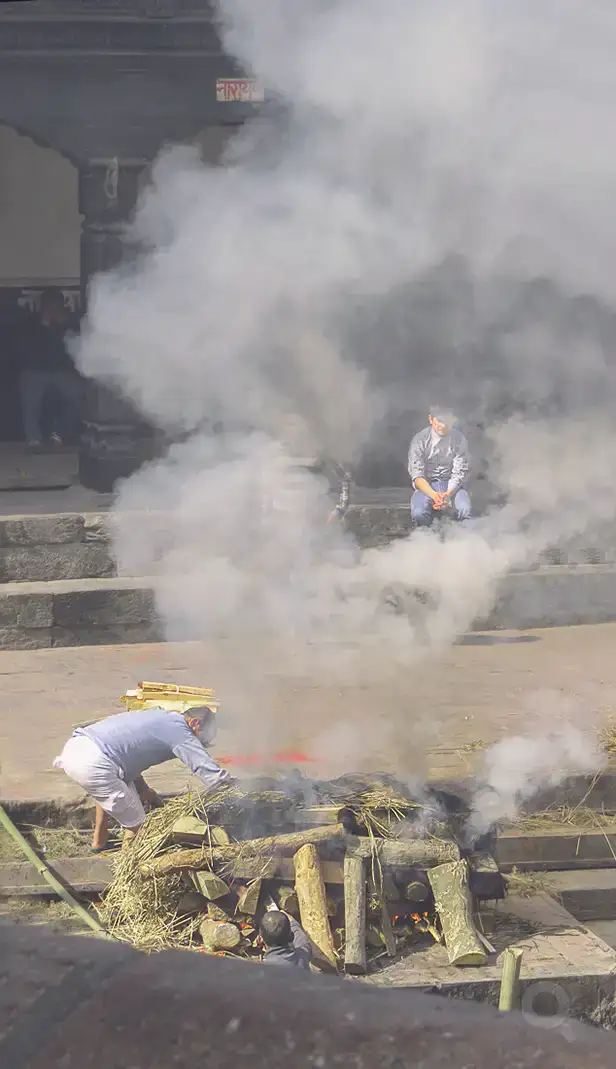
Two Brahmins, sometimes three or more, of matte white cotton, have come forward and arranged very skillfully, with repeated dexterity, the bed of logs where the corpse will be placed, surrounded by a seamless shroud. Three rows of proportioned and staggered logs, each in two sections to better direct a balanced fire to the head and feet, which are generally left suspended and bare, build the pyre in which everything wrapped up will burn, without losing its level at any time.
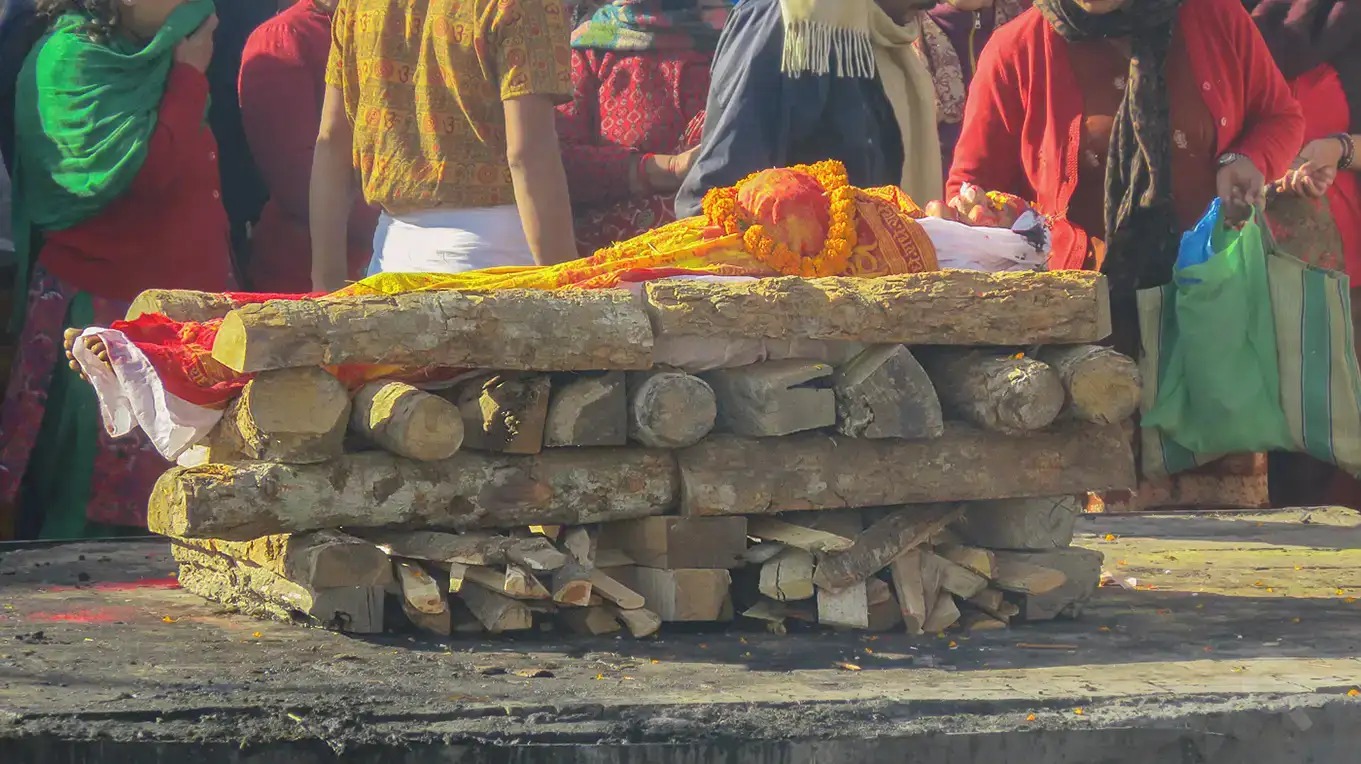
Moments prior to the start of cremation.
Combustion and cremation rite
Covered by bundles of straw, conveniently rinsed beforehand by suddenly immersing them in the waters of the river and left to drain in cones, the bonfire is fed with small firewood (around two hundred and fifty kilos) and small sacks of animal fat [ghee] placed between the air chambers of the device to fan the fire (sandalwood, due to its high cost, is very very exceptionally used).
A first flashit ignites and reaches for the inert head and chest, then races through the rest of the mortuary bed, giving off a flame of intense light that soon becomes a firm column of rising whitish smoke, drowned out by quick, dry noises of the first crackling.
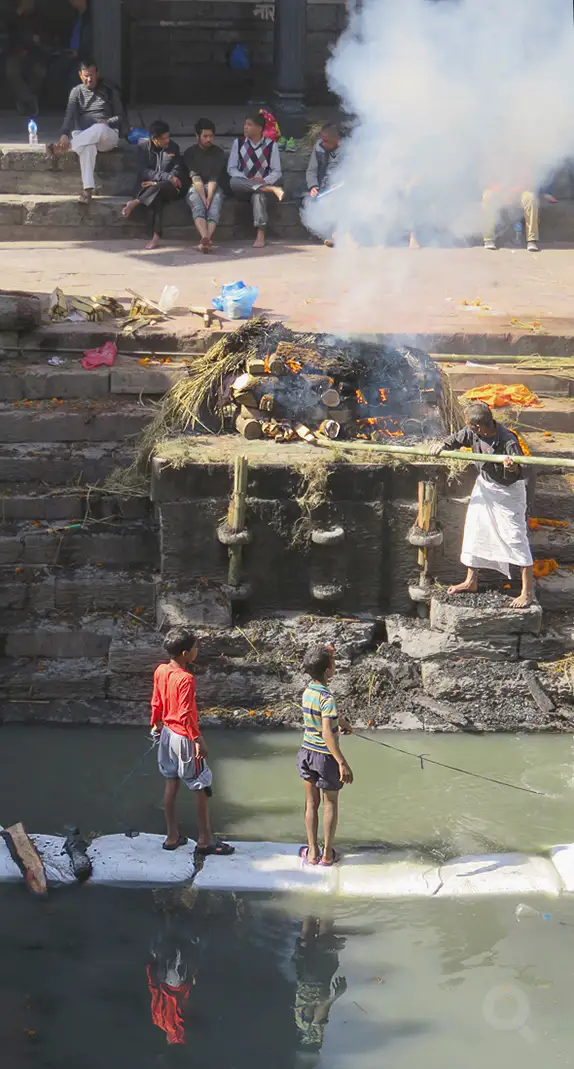
Combustion and ritual will last for hours, depending on the state and nature of the corpse., from three on average to more than five in some cases, assisted by the same Brahmins, who walk up the steps with natural elegance, now equipped with bamboo poles [ban o bars] to take care of the live embers until they are consumed and finished.
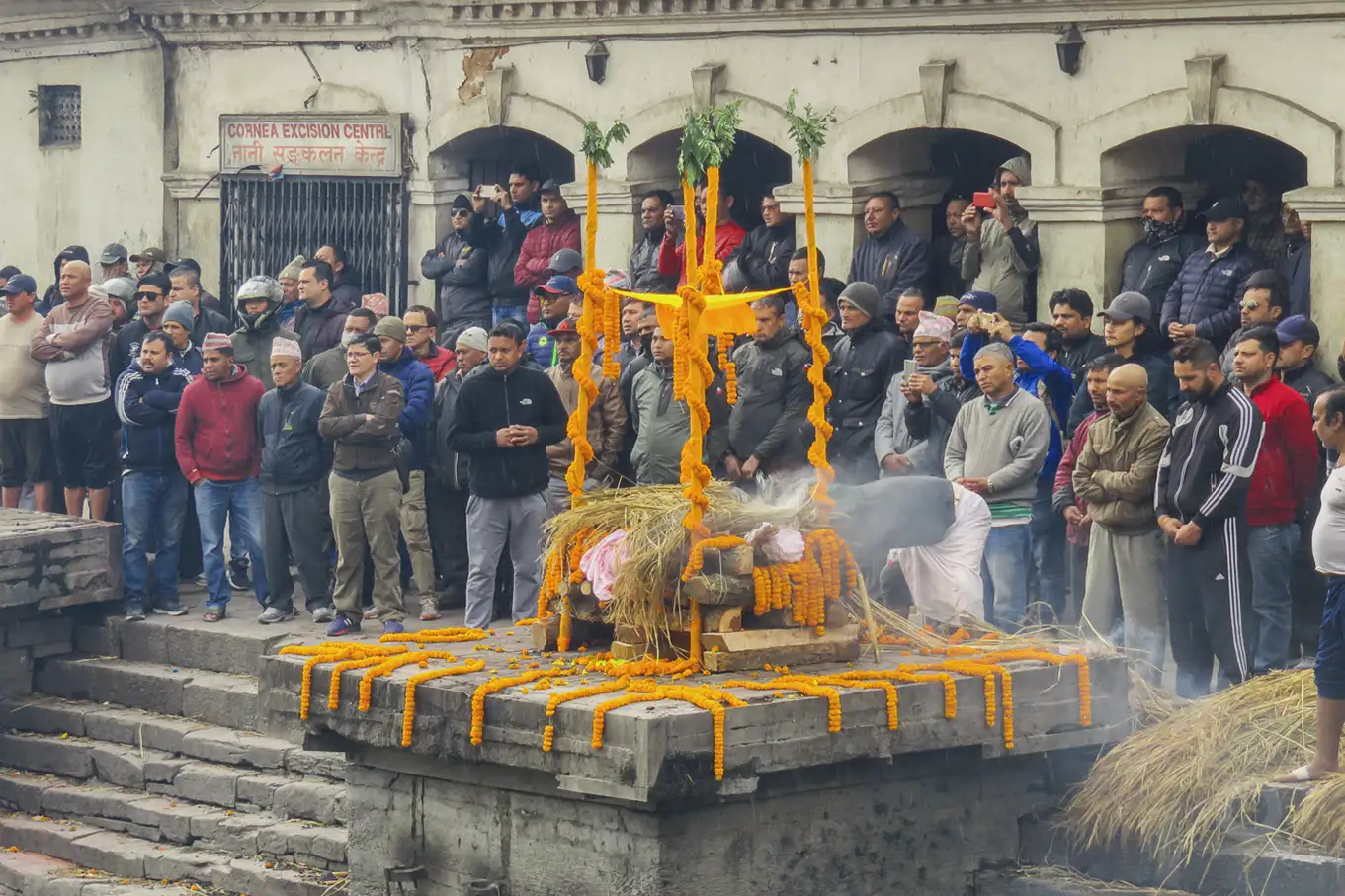
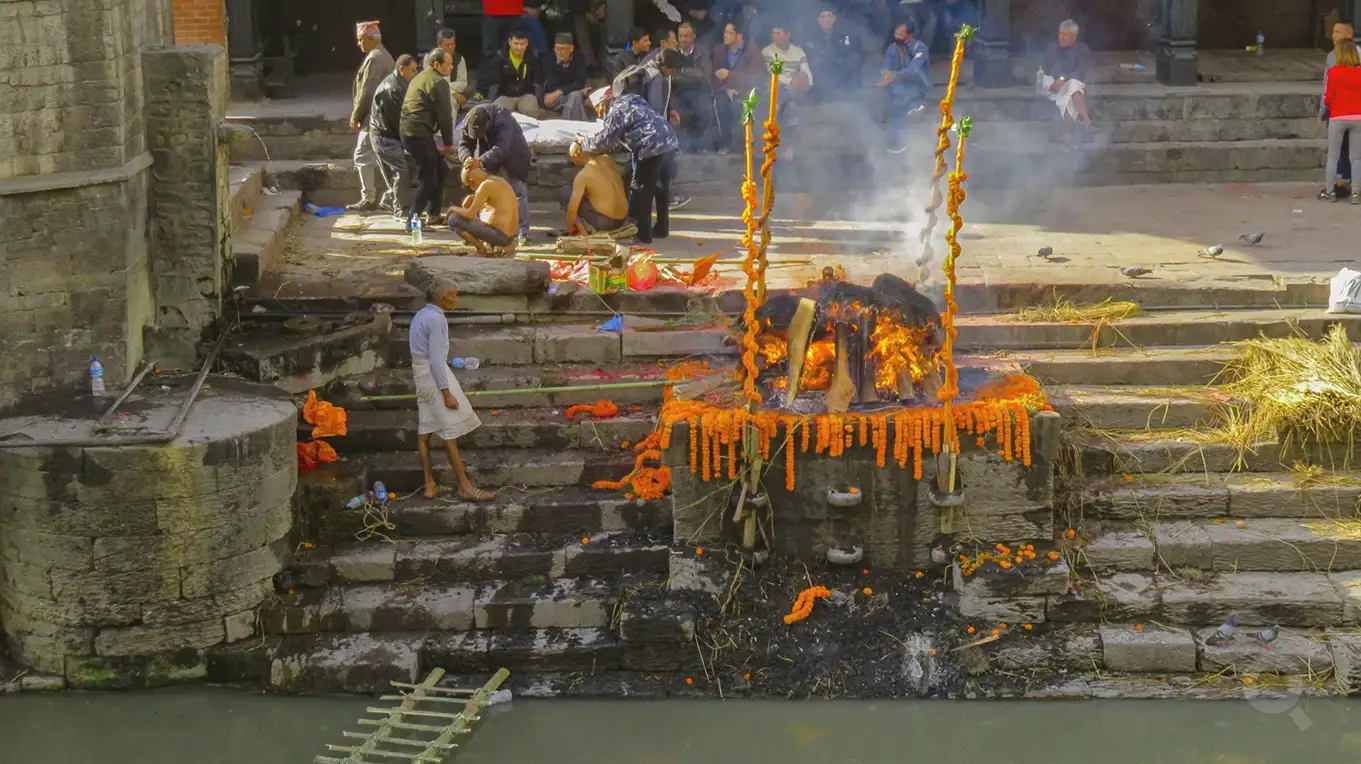
Moments from two different cremations of wealthy families, with richly decorated platforms.
Although sometimes there are remains of logs that end up swept straight into the riverbed, the pyre is reduced to a small pile of ashes, then swept with buckets of water taken from the shore amidst clouds of serene and slow steam, a product of the intense heat absorbed by the platform after all that time and which in successive breaths completely erases - and even purifies if there is faith - the signs of death and all its ceremonial, up to the next duel, which waits at the edge of the staircase, without end.
The burning and the ritual will last for hours, depending on the state and nature of the corpse, sometimes three to five hours❞.
Before leaving him on the bed that awaits him, the dead man is turned three times in a clockwise direction, representing the path of eternal return and the perfection. Then the cremation itself begins while the family waits, divided by sex, in the background, except for the first-born or the most direct relative, who will light the flame. As I could see after weeks, it is not usual for them to remain until the end, until the complete sweep of the ghat.
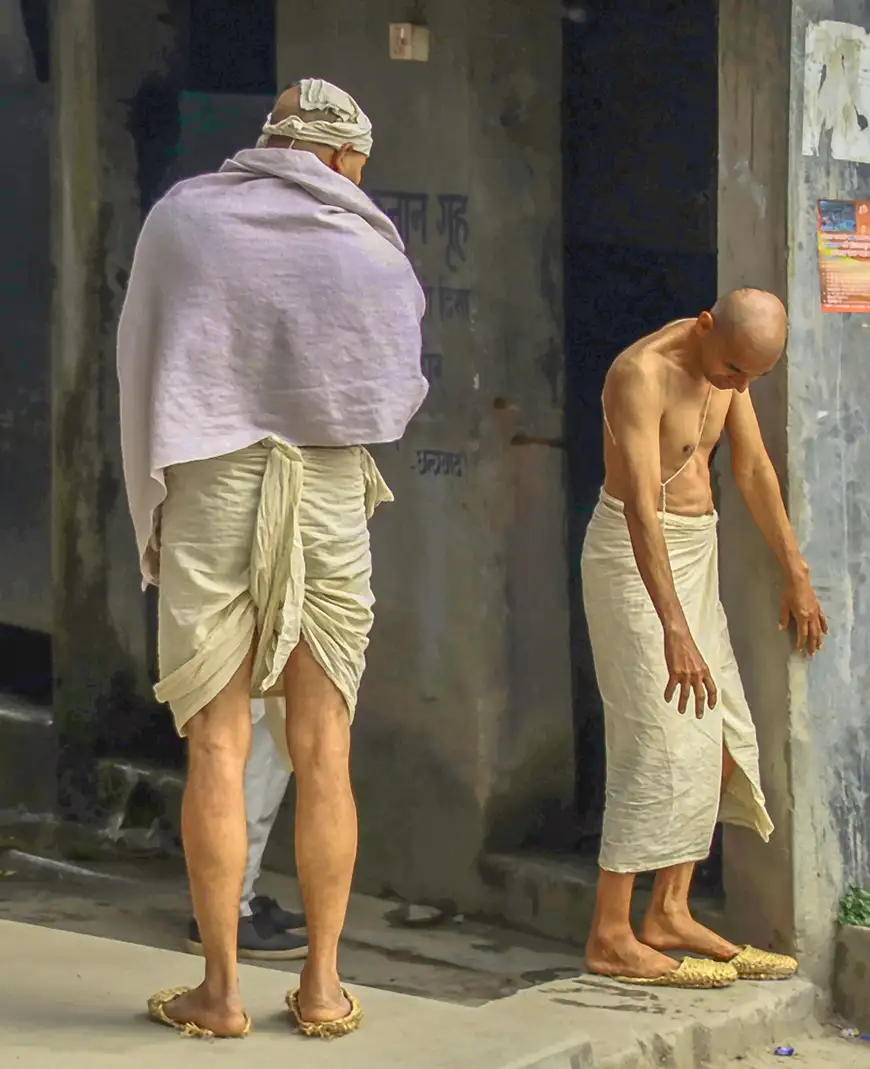
At a point where cremation has once the body and the wood have been devoured, the men wash their heads and necks with the water that flows from the fountains on both sides of the bridge's entrance. of stone that saves the banks of the Bagmati and then shave their heads with a razor, or leave a thin ponytail [tupi], or they cut to zero, although this does not always occur ritual closure with shave.
Funeral of a member of the Government of Nepal who died in a plane crash (2018).
Among members of the Bahun caste, it is common to approach the bank of the Bagmati River for a synchronized ablution, and the firstborn, having collected a handful of ash and wrapped it in a piece of cloth, enters the river and dips it to the bed.
Except during the Shivaratri festival days, the largest annual celebration in honor of Siva, with a large influx of shadus, because Pashupatinah is not, contrary to what can often be read in express blogs, a place of concentration for them the rest of the year, it is highly unlikely to see them come to collect the ashes and smear themselves with them as they do in Varanasi.
The mourning will continue for the next ten days. in a rite [sraddha], not only religious but also social, that male relatives, considered impure, still surrounded by certain taboos, have to celebrate in honor of the deceased, to provide a new spiritual body to the naked soul after cremation and thus facilitate its transit to the next life. ✑REGION
Postscript: At the beginning of 2016, its first electric crematorium, a challenge for the traditional funerary practice seeking a harmonic continuity between live fire and electricity, tradition and progress, technology and the environment.
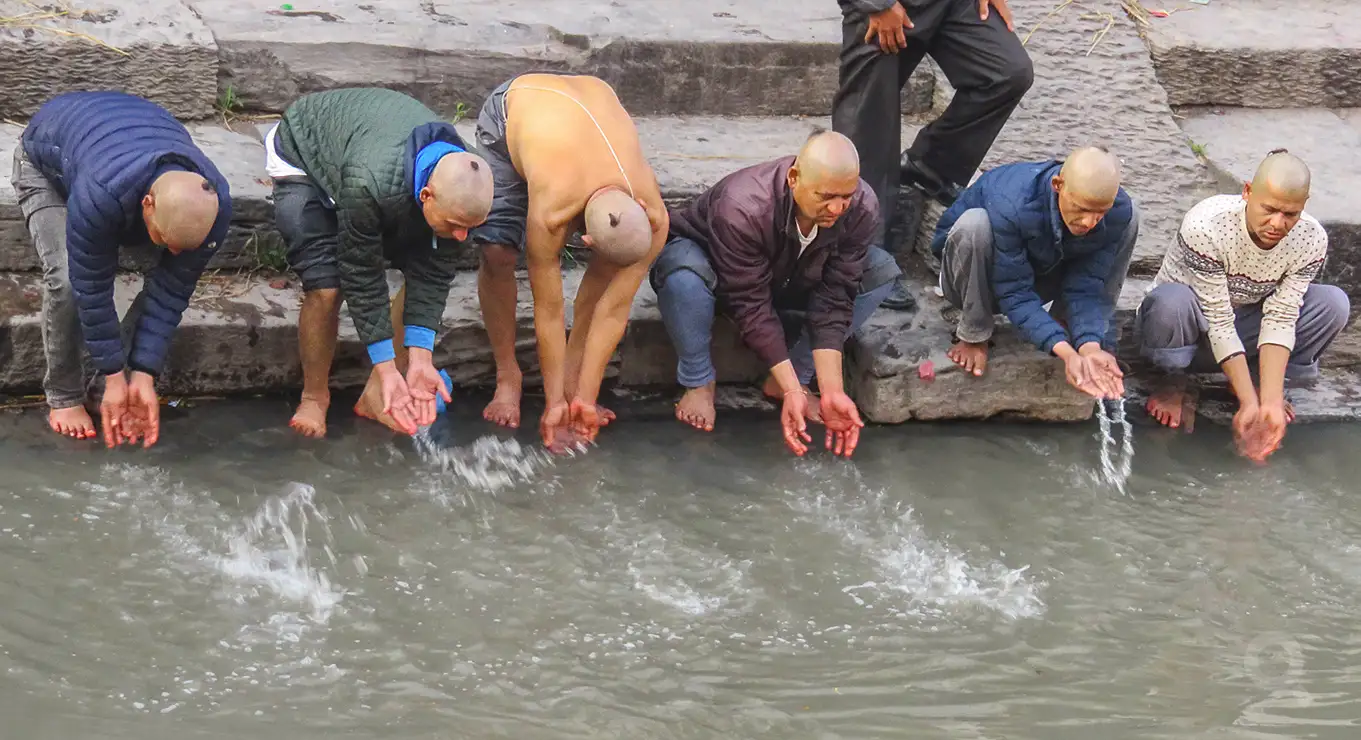
Moment of the final ablution and prior to burying the ashes in the alveo of the Bagmati River.
Nepalese funeral rites impact Westerners because of the different concept of death depending on religion or culture. We Westerners are anguished by death, we avoid it and it is difficult for us to face it, while for Hindus it is a transition to a new rebirth, they have had a pre-existing life and after death they will reincarnate again, for Hindus death is not the end, but the beginning of a new life. Congratulations for this interesting post, illustrated by some beautiful photos. Thank you for sharing it, traveling allows us to compare and see the differences between uses and customs, mentalities and procedures in other cultures and religions, peoples and populations, it opens up new perspectives and makes us more empathetic. This blog transports us to Nepal as if it were a virtual trip, opening our eyes to a completely different culture. Congratulations and, as they say in artistic slang, I wish you 'a lot of shit'.
Thank you very much for leaving your comment, the first on the web, historical :-))
Nepal, like the entire Himalayas, is another world for Westerners, I would almost say obligatory to see and enjoy.
A lot of shit (^ v ^)
Good morning, I put it on the agenda. A journey of contrasts, opening up horizons and getting closer to oriental culture, from which we also have a lot to learn. All the best.
Very interesting article.
Thanks for the comment. I'm glad to know that you found it interesting.
Thank you!
Firstly, I would like to thank you for publishing this wonderful article about Nepali rituals and culture.
Being a Nepali, I can really relate this cultural belives that we follow. After reading your article, I really impressed. Whatever, you mention in this article is really true.
Namaste, so thanks for your kind comment!
One of the last sacraments among 16 sanskaras of Hindus is Antyesti which allows the soul to be free to the next life from the physical realm. And so he said, Pashupatinath is a very honorable place to practice the last ritual as the abode of Shiva liberates to soul to the ultimate reality. A very well researched article that allows readers to travel to this place and feel the imaginary sentiment. The whole comes out of the whole and dissolves with the whole eventually. We are the spark of divinity and the purpose of our existence is to accept it and uncover the divine soul towards Brahman. Our physical body is immortal but what is eternal is our soul. Never been created and never will be destroyed. Thanks for the article to enlighten people to celebrate death and accept it.
Namaste, thanks for your accurate comment, I really appreciate it!
Thanks a lot for your valuable feedback!
Great! Thank you so much for your time to write this article about Nepalese funeral rites with different concept of death depending on religions and culture. Many Greetings from Nepal. Best wishes!
Namaste, the most important thing about Nepal is its wonderful people. Thank you very much for your comment!!!